What happens when your logo gets embroidered?
Every stitch has a job.
But not every logo is suited to embroidery.
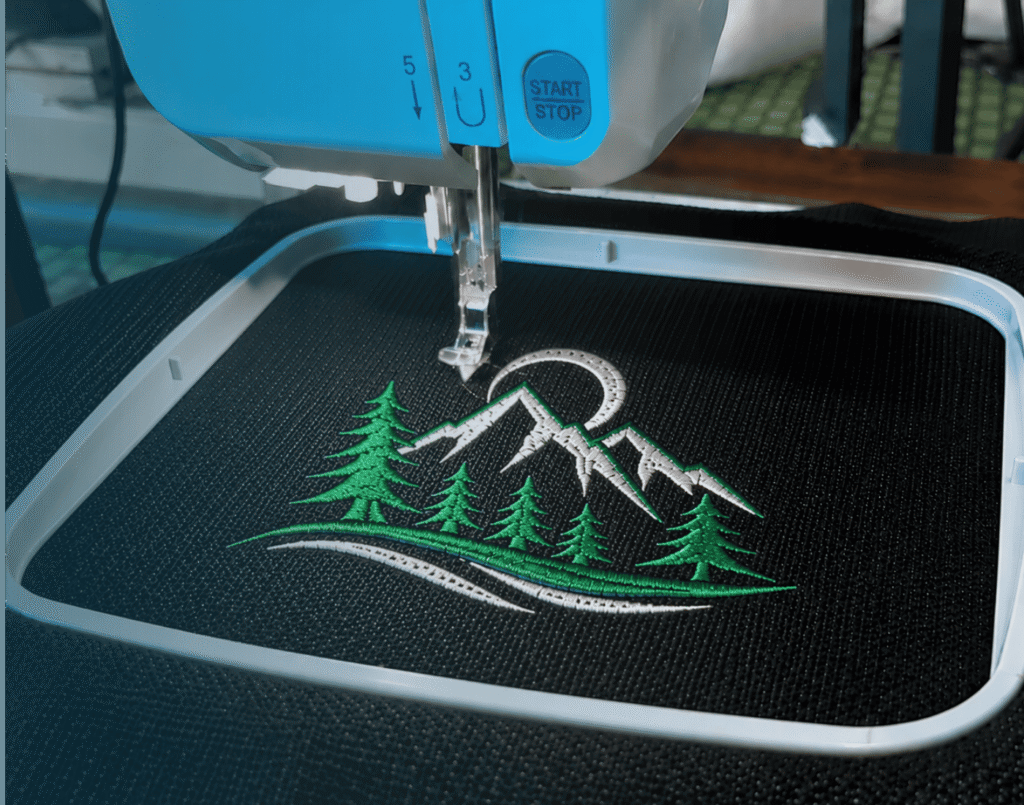
The average embroidered chest logo can contain around 4,000–8,000 stitches. Each one is placed by an embroidery machine, building up thread to recreate your design on the garment.
Think about that for a moment. A logo you normally see as a flat image on a screen is being recreated using thousands of individual stitches, each contributing to the finished result.
It’s one of the reasons embroidery has such a distinctive, premium feel. The texture, the dimension and the way the thread catches the light give a garment a finish that printing simply can’t replicate.
But there’s a catch.
Not every logo is suitable for embroidery.
Your logo wasn’t necessarily designed for thread. Most logos are designed to work on a screen, a website, a business card or a printed document. They’re often created using fine lines, small text, intricate details and subtle colour variations.
Those elements can look fantastic on a screen. On fabric, they can become a problem.
Embroidery works by building a design out of stitches. Thread has physical thickness, and fabric moves. Very fine details can disappear, small lettering can become difficult to read, and tightly packed elements can merge into one another.
A gradient, for example, can’t be reproduced in embroidery in the same way it appears on a screen. Intricate illustrations may lose definition, while tiny text can become an unreadable tangle of thread.
That doesn’t mean your logo is bad. It simply means the design needs to work in a different medium.
What makes a logo suitable for embroidery?
In general, embroidery works particularly well with designs that have:
Clear shapes and defined edges. Simple, recognisable elements tend to translate well into stitches.
Text that’s large enough to read. Small lettering can be one of the biggest challenges, particularly on a chest logo.
A manageable number of colours. Multiple thread colours are possible, but more colours can add complexity and production time.
Enough space between elements. Fine gaps and closely packed details can disappear when converted into stitches.
These aren’t absolute rules. The result also depends on the garment, the fabric, the size of the design and the embroidery technique. An experienced digitiser can often make adjustments to improve the result. The important thing is to assess the design before production begins, rather than discovering its limitations after the garments have been made.
Sometimes your logo needs adapting
One of the most important steps in embroidery is digitising. This is the process of converting your artwork into instructions that tell the embroidery machine how to stitch the design. It involves decisions about stitch types, direction, density, sequencing and other details that affect the finished result. It’s not simply a case of uploading an image and pressing start.
A design may need simplified details, adjusted lettering or changes to spacing. Sometimes a separate version of the logo is the best solution, one optimised for embroidery while the original remains unchanged for other uses.
The goal isn’t to redesign your brand. It’s to reproduce it in a way that works on the garment.
When printing might be the better option
If your logo contains intricate artwork, very small text, gradients or fine details that are essential to its appearance, printing may be a better fit.
Heat transfer and other printing methods can reproduce certain details that are difficult to achieve with thread. They also create a different finish, which may suit your brand and garment better.
Neither method is automatically superior.
Embroidery offers texture, dimension and a traditional premium appearance. Printing can offer greater flexibility for complex artwork and certain design styles. The right choice depends on what you’re trying to achieve, how the garment will be used and how the finished design needs to look.
Look closer next time
The next time you see an embroidered logo, take a closer look. Notice the texture. The way the thread follows the shapes. The tiny details that have been recreated stitch by stitch.
There’s a lot more going on than most people realise.
And if you’re considering embroidered uniforms for your business, you don’t need to understand every technical detail yourself. You just need to work with someone who can look at your logo, understand what you’re trying to achieve and recommend the right approach.
Because a good result starts long before the first stitch.
It starts with knowing what will work.